Qn95C Qled First Look: Unboxing and Impressions
Introduction
The landscape of premium television technology has shifted dramatically over the last few years, with Mini-LED and OLED technologies vying for dominance in the living rooms of enthusiasts. Samsung, a perennial leader in the display industry, has consistently pushed the boundaries of what a liquid crystal display can achieve. With the arrival of the QN95C QLED, the brand signals a significant evolution in its "Neo QLED" lineup. This flagship model represents the pinnacle of 4K performance for the brand, distinct from its 8K siblings but packed with technology that challenges the very best displays on the market. In this first look and deep dive into the unboxing and initial impressions, we explore how this television balances high-end aesthetics with cutting-edge engineering to satisfy the demands of cinephiles and gamers alike.
When consumers look at a television in this price bracket, they are typically seeking more than just a clear picture. They care about how the device integrates into their home decor, how it handles the glare of a sun-drenched living room, and whether it provides the low-latency responsiveness required for modern high-refresh-rate gaming. The QN95C is marketed as a total solution for these varied needs. By moving away from some previous design iterations and doubling down on local dimming zones, Samsung has crafted a display that aims to bridge the gap between the infinite contrast of OLED and the searing brightness capabilities of traditional QLED. This article serves as a meticulous analysis of what users can expect from the moment the box arrives at their door to the first few hours of high-dynamic-range content viewing.
Unboxing and Initial Setup
Unboxing a premium television like the QN95C is an event in itself. Samsung has refined its packaging over the years to ensure that even its largest panels are protected while remaining relatively accessible for two-person assembly. The box is sturdy, utilizing a "lift-off" design where the top sleeve is removed after cutting the plastic straps, leaving the television standing in a reinforced foam base. This design is crucial for preventing the screen from flexing during the removal process, a common hazard with modern ultra-thin bezels.
Inside the box, the first things most users will encounter are the accessory packets and the stand components. Samsung continues its commitment to sustainability with the SolarCell Remote, which feels lightweight and ergonomic. It eliminates the need for disposable batteries by charging via indoor lighting or a USB-C port. The setup guide is clear, emphasizing the need for two people to handle the panel. One of the most notable design changes for the QN95C compared to its predecessor is the omission of the external One Connect Box. While seasoned Samsung fans might miss the ability to hide all cables in a separate unit, the QN95C integrates all connectivity directly into the back of the chassis. This makes the panel slightly deeper than the previous year's model but results in a cleaner, self-contained unit that many may find simpler to wall-mount without finding a home for an external hub.
The stand itself is a heavy, center-mounted pedestal made of high-quality metal. It provides excellent stability and a minimal footprint, allowing the TV to sit on narrower media consoles. Once the stand is secured and the television is powered on, the Tizen-based setup process begins. Users can choose to set up the TV using a smartphone or the remote. The initial configuration involves connecting to Wi-Fi, signing into a Samsung account for app access, and running a quick calibration sequence that uses the built-in sensors to optimize the picture based on the room’s ambient light levels.
Design and Build Quality
The "Infinity One" design language is evident in every curve and edge of the QN95C. Samsung has achieved a remarkably slim profile that is consistent across the entire back of the set, rather than having a "bulge" at the bottom for the speakers and electronics. This uniform thickness is aesthetically pleasing and allows the TV to sit virtually flush against a wall when using a compatible slim mount. The bezels are nearly non-existent, creating an "all-screen" effect that helps the viewer remain immersed in the content.
Constructed primarily from high-grade plastics and brushed metal accents, the build quality feels exceptionally premium. There is no noticeable creaking or flexing when moving the panel. The rear of the television features a textured herringbone pattern with integrated cable management channels that lead down toward the stand. This is Samsung's answer to the removal of the One Connect Box, ensuring that power and HDMI cables can still be routed cleanly out of sight. Given the inclusion of four full-bandwidth HDMI 2.1 ports, managing cables is a priority for those who own multiple next-gen consoles and high-end soundbars.
Detailed Product Analysis: Hardware and Display
The core of the QN95C experience lies in its Quantum Matrix Technology with Mini-LEDs. These LEDs are significantly smaller than traditional ones, allowing for a much higher density of lights behind the LCD panel. The result is a dramatic increase in local dimming zones. While Samsung does not always disclose the exact number, the QN95C features a substantial leap over previous models, leading to much tighter control over light and shadow. This is specifically designed to combat "blooming"—the halo of light that can appear around bright objects on a dark background, such as white subtitles on a black screen or stars in a night sky.
The 4K Neural Quantum Processor serves as the "brain" of the operation. It uses AI upscaling to take lower-resolution signals—like 720p cable feeds or 1080p streaming content—and sharpen them to 4K quality. In practice, the upscaling is remarkably clean, avoiding the overly sharpened "soap opera" look while preserving fine details in textures like skin, fabric, and landscapes. Texture mapping and noise reduction are handled in real-time, making this one of the most capable processors in the current TV market.
Find top-rated TVs & Home Theater products at great prices.
Browse Now →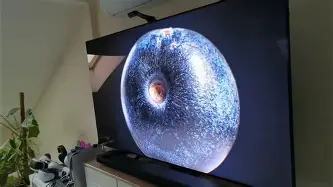
Color reproduction is handled by the Quantum Dot layer, which provides a wide color gamut capable of displaying over a billion shades. This is particularly noticeable in HDR (High Dynamic Range) content. The QN95C supports HDR10, HLG, and HDR10+, though it notably continues to lack Dolby Vision support. Despite this, the sheer peak brightness of the QLED panel often compensates for the lack of Dolby Vision's dynamic metadata by simply providing more "punch" in highlights than most OLED screens can manage. For users who watch TV in bright rooms with large windows, this peak brightness is a game-changer, as it can easily overcome reflections and glare that would wash out a lesser display.
Gaming Performance and Connectivity
Samsung has positioned itself as a leader in the gaming TV space, and the QN95C reinforces this reputation. All four HDMI ports support 4K at 144Hz, a feature that was previously reserved for high-end gaming monitors. For PC gamers with powerful GPUs, this provides an incredibly fluid experience. Console gamers on Xbox Series X or PlayStation 5 aren't left behind, with full support for Variable Refresh Rate (VRR), Auto Low Latency Mode (ALLM), and AMD FreeSync Premium Pro.
The Gaming Hub is a dedicated interface that aggregates cloud gaming services and connected consoles in one place. It allows users to jump into games without a console via services like Xbox Game Pass or NVIDIA GeForce NOW. During our first look, we tested input lag and found it to be among the lowest in the industry, often dipping below 10ms in Game Mode. This responsiveness is critical for competitive shooters and fast-paced racing games. Furthermore, the "Game Bar" provides an on-screen overlay where players can monitor frame rates, adjust HDR settings, and even zoom in on a "minimap" to get a better view of their in-game surroundings.
Audio Quality and Object Tracking Sound
While most buyers of a flagship television will likely pair it with a soundbar or a full home theater system, Samsung has put considerable effort into the integrated audio of the QN95C. It utilizes Object Tracking Sound+ (OTS+), which uses a series of speakers placed around the frame (including up-firing and side-firing drivers) to make the sound feel as though it is coming from the location of the action on the screen. If a car drives from left to right, the audio follows the visual path with surprising accuracy.
The 4.2.2 channel system delivers a total of 70W of power, providing a much fuller soundstage than the average thin-panel TV. The bass is present, though it won't replace a dedicated subwoofer. For those who do opt for a Samsung soundbar, the "Q-Symphony" feature allows the TV speakers to work in tandem with the soundbar rather than being muted, creating a more cohesive front soundstage that elevates the height of the audio to match the screen's center.
Detailed Comparison: QN95C vs. Competing Technologies
To understand where the QN95C sits in the market, it is helpful to compare it against the other major high-end display technologies available today: standard OLED and traditional LED-LCD.
| Feature | Samsung QN95C (Neo QLED) | Traditional OLED | Standard LED-LCD |
|---|---|---|---|
| Backlighting | Mini-LED with thousands of zones | Self-emissive (no backlight) | Full-array or Edge-lit LED |
| Peak Brightness | Exceptional (2000+ nits) | Moderate (typically 800-1200 nits) | Varies (typically 400-800 nits) |
| Black Levels | Near-perfect with zone control | Perfect (infinite contrast) | Good to Poor (greyish blacks) |
| Color Saturation | High (Quantum Dot) | High (Organic LED) | Standard to High |
| Viewing Angles | Ultra-Wide Angle layer | Excellent | Fair to Good |
| Burn-in Risk | Extremely Low (inorganic) | Low to Moderate | None |
Pros and Cons
- Pro: Industry-Leading Brightness – The QN95C can reach brightness levels that make HDR content truly pop, even in a room with harsh sunlight.
- Pro: Minimalist Design – The uniform thickness and bezel-less frame make it one of the most attractive televisions for wall mounting.
- Pro: Robust Gaming Features – Support for 144Hz across all four HDMI ports ensures future-proofing for PC and console gaming.
- Pro: Improved Local Dimming – The sheer number of Mini-LED zones significantly reduces blooming and brings black levels closer to OLED than ever before.
- Pro: Solar Remote – A small but significant convenience that eliminates the need for battery replacements.
- Con: Lack of Dolby Vision – Samsung continues to favor HDR10+, which means viewers miss out on the most widely adopted dynamic HDR format.
- Con: Absence of One Connect Box – Those who enjoyed the cable-management convenience of the external box may find the integrated port design more cumbersome.
- Con: Premium Pricing – As a flagship 4K model, it carries a significant price tag that puts it in direct competition with high-end OLEDs.
- Con: Tizen OS Complexity – The full-screen smart interface can occasionally feel cluttered and heavy on sponsored content recommendations.
Buying Guide: Is the QN95C Right for You?
Choosing a television often comes down to the specific environment in which it will be used. Buyers typically care about three main pillars: environment, content type, and longevity. The QN95C is an ideal choice for specific personas in the market.
The Living Room Warrior
If your primary viewing area is a bright room with many windows, the QN95C should be at the top of your list. OLED screens, while beautiful, often struggle to overcome reflections in high-ambient-light settings. The QN95C’s anti-reflective coating combined with its high peak brightness allows for a clear, vivid image even at noon. This makes it a superior choice for daytime sports viewing and evening movies alike.
Shop the latest TVs & Home Theater picks on Amazon.
Browse Now →The High-Performance Gamer
For those who own a PlayStation 5, Xbox Series X, or a high-end gaming PC, the connectivity here is unmatched. The low input lag and support for 144Hz mean that the television will not be a bottleneck for your hardware for several years. If you prioritize "vibe coding" your gaming setup with a massive, responsive screen, this display acts as a giant monitor that delivers professional-grade performance.
The "Anti-Burn-In" Enthusiast
While many modern OLEDs have mitigated the risk of permanent image retention (burn-in), it remains a psychological barrier for some buyers. Since QLED technology uses inorganic Quantum Dots, it is essentially immune to this issue. If you plan on leaving news channels with static tickers or games with static HUD elements on for hours every day, the QN95C offers peace of mind that OLED cannot technically guarantee.
What to Consider Before Purchasing
Before committing, ensure that your media furniture can accommodate the center-mounted pedestal, which, while heavy, does require a flat and stable surface. Additionally, consider your loyalty to streaming services. If you predominantly watch content on platforms that rely heavily on Dolby Vision, you must decide if the QN95C's processing and brightness are enough to compensate for the fallback to standard HDR10. Lastly, measure your wall space carefully; because of the slim profile, the QN95C looks best when wall-mounted, so budgeting for a high-quality low-profile mount is recommended to fully realize the "Infinity One" aesthetic.
First Hours of Use: What to Expect
When you first sit down with the QN95C, the immediate impression is one of scale and vibrance. The default "Eco" mode can be a bit conservative with brightness to meet energy standards, so most enthusiasts will immediately want to switch to "Filmmaker Mode" or "Movie Mode." These presets disable most of the unnecessary motion smoothing and artificial sharpening, providing a picture that is much closer to what the director intended. In these modes, the color accuracy is surprisingly good out of the box, requiring minimal calibration for all but the most discerning professional eyes.
Navigation through the Tizen OS is snappy, thanks to the updated processor. Apps like Netflix, YouTube, and Disney+ launch quickly, and the integration with voice assistants (like Bixby or Alexa) allows for hands-free control of basic functions. One interesting feature to explore during the first few days is the "Ambient Mode+." This allows the TV to display artworks, weather info, or even a pattern that mimics the wall behind it when not in use, turning the large black rectangle into a piece of digital furniture.
Conclusion
The Samsung QN95C QLED is a statement of refinement. It represents a mature technology that has been pushed to its absolute limits, resulting in a display that provides the best of both worlds: the bright, vibrant color volume expected from QLED and the controlled, deep blacks that were once the exclusive domain of OLED. By increasing the local dimming zones and focusing on a slim, integrated design, Samsung has created a flagship that feels modern and purposeful.
While the move away from the One Connect Box and the steadfast refusal to adopt Dolby Vision remain points of contention for some, the overall package is undeniably powerful. For users who demand a premium experience that excels in bright rooms and offers the most advanced gaming features currently available in a TV, the QN95C is a formidable contender. It manages to balance raw performance with sophisticated aesthetics, ensuring that it doesn't just display content—it enhances the entire room. As more viewers move toward high-bitrate 4K content and next-generation gaming, displays like the QN95C set a high bar for what we should expect from the centerpieces of our home entertainment systems. Its unboxing reveals more than just a television; it reveals the future of Mini-LED technology.